The Invisible Margin Killer: Solving Gaming Chargebacks with a Merchant of Record

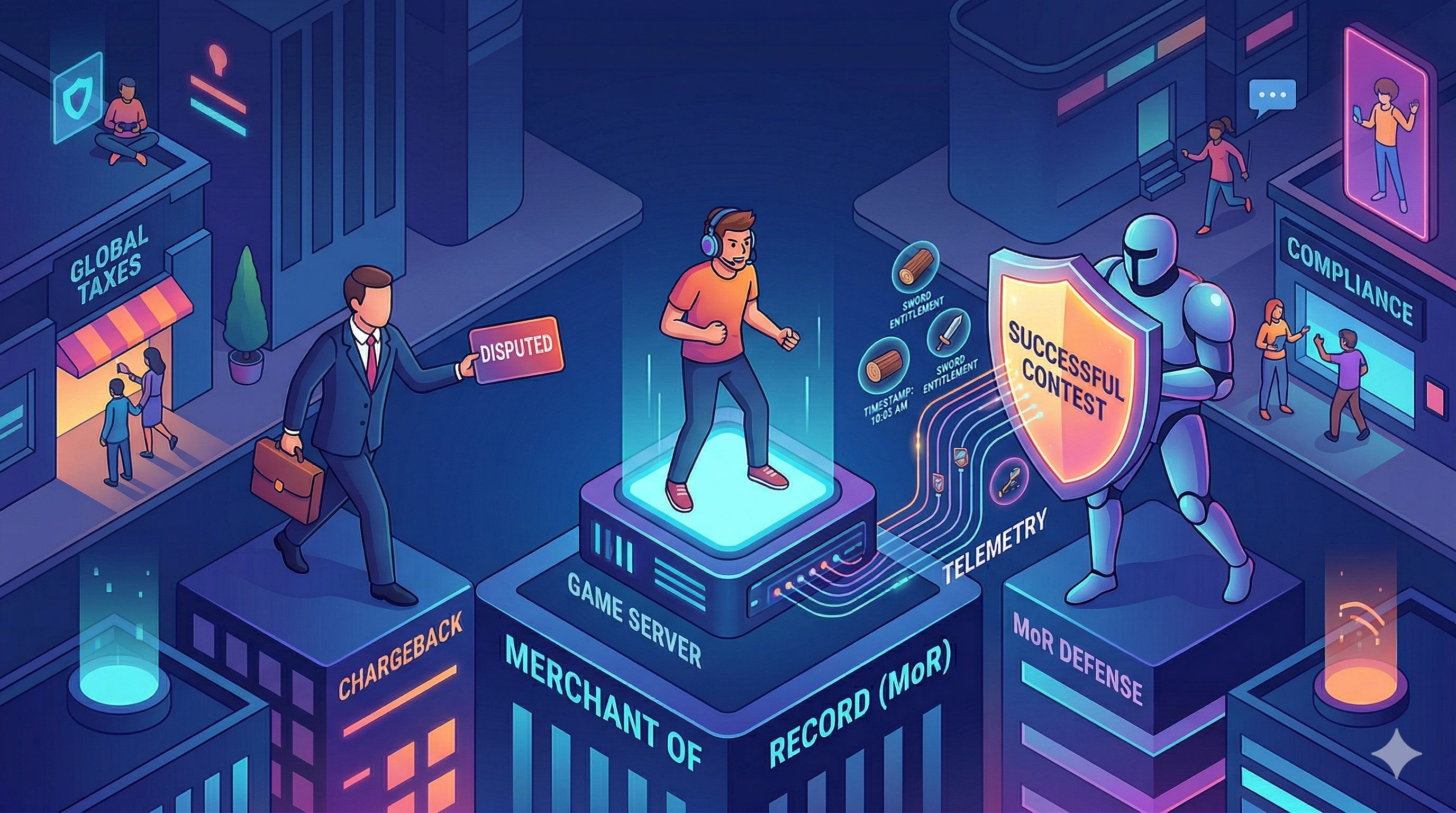
In the high-velocity world of Live Ops, chargebacks are more than just a financial nuisance - they are an operational tax. When a player disputes a $5 microtransaction, the time your team spends investigating, documenting, and contesting that claim often far exceeds the value of the sale itself.
The math is brutal: according to LexisNexis research, for every $1 of fraud, merchants actually lose $4.61 once you factor in overhead, legal fees, and indirect costs. For a gaming studio, this workload is usually the first thing to break.
What is a Merchant of Record (MoR)?
Think of an MoR as your legal buffer. Instead of you selling directly to the player, the MoR acts as the official seller. They sit between your game and the payment networks, handling:
Payment Processing: Using their own regulated merchant accounts.
Tax Remittance: Calculating and paying VAT/Sales tax globally.
Dispute Management: Owning the entire operational workflow for chargebacks.
In gaming, disputes usually stem from three areas: “friendly fraud” (parents disputing a child’s purchase), account takeovers (ATO), or simple confusion over recurring subscriptions.
The Anatomy of a Managed Dispute
While every provider has their own secret sauce, a gaming-centric MoR (like Tebex) follows a specific lifecycle to protect your revenue:
1. The Proactive Defense
By using embedded checkouts, players never leave the game environment. This continuity reduces unrecognized transaction claims. The MoR captures IP signals and device fingerprints at the moment of purchase to build a digital paper trail.
2. Evidence Capture (The Game Telemetry)
This is where gaming MoRs shine. They link the payment to virtual item grants. When a bank asks for proof, the MoR provides a timestamped log showing exactly when the player received their diamond sword or battle pass.
3. Dispute Contesting: The “Fight” Phase
The MoR manages the entire dispute contesting process - submitting evidence packages to the issuing bank. They decide whether to contest a claim based on transaction value and the quality of evidence, saving your team from manual data entry.
4. The Feedback Loop
A spike in disputes isn’t just a loss, it’s data. If subscription disputes are rising, your MoR’s reporting will signal that you need clearer renewal notifications or a more intuitive “one-click” cancellation flow.
MoR vs. The Alternatives: Which Strategy Wins?
You don’t always need a full MoR, but you should know what you’re trading off:
The MoR Model (e.g., Tebex): You get a “Full Stack” solution. They handle the liability, the taxes, and the disputes. Many gaming-specific MoRs even offer 100% Chargeback Insurance, capping your financial exposure entirely.
Dispute Management Services: These are specialists who “fight” disputes for you. They offer great expertise but do not handle your taxes or payment processing. You still hold the legal liability.
Alert Networks (Ethoca/Verifi): These act as an early warning system, allowing you to refund a transaction before it becomes a formal chargeback. Useful for deflection, but they don’t manage the underlying tax or compliance burden.
Your Partner Checklist: 5 Questions to Ask
Before signing with a DTC partner, demand a demo. Ask to see:
The Seller Insurance Policy: Does it cover “Friendly Fraud”? Get the specific payout criteria in writing.
Anonymized Case Studies: Ask to see three anonymized successful contests from the last year involving virtual goods.
Local Payment Support: Do they offer local methods in high-risk regions to reduce reliance on easily-disputed credit cards?
Self-Service Portals: Can players manage their own cancellations? (A “Cancel” button is your best defense against a chargeback).
Telemetry APIs: How easily does their system ingest your game’s fulfillment logs?
The Bottom Line
An MoR turns a chaotic cost center into a predictable line item. For studios handling high volumes of low-ticket transactions, manual handling is a losing game. By offloading the legal seller status to a partner, you aren’t just outsourcing payments - you’re buying yourself industrial peace.